Dental Crowns and Bridges in Wheelers Hill
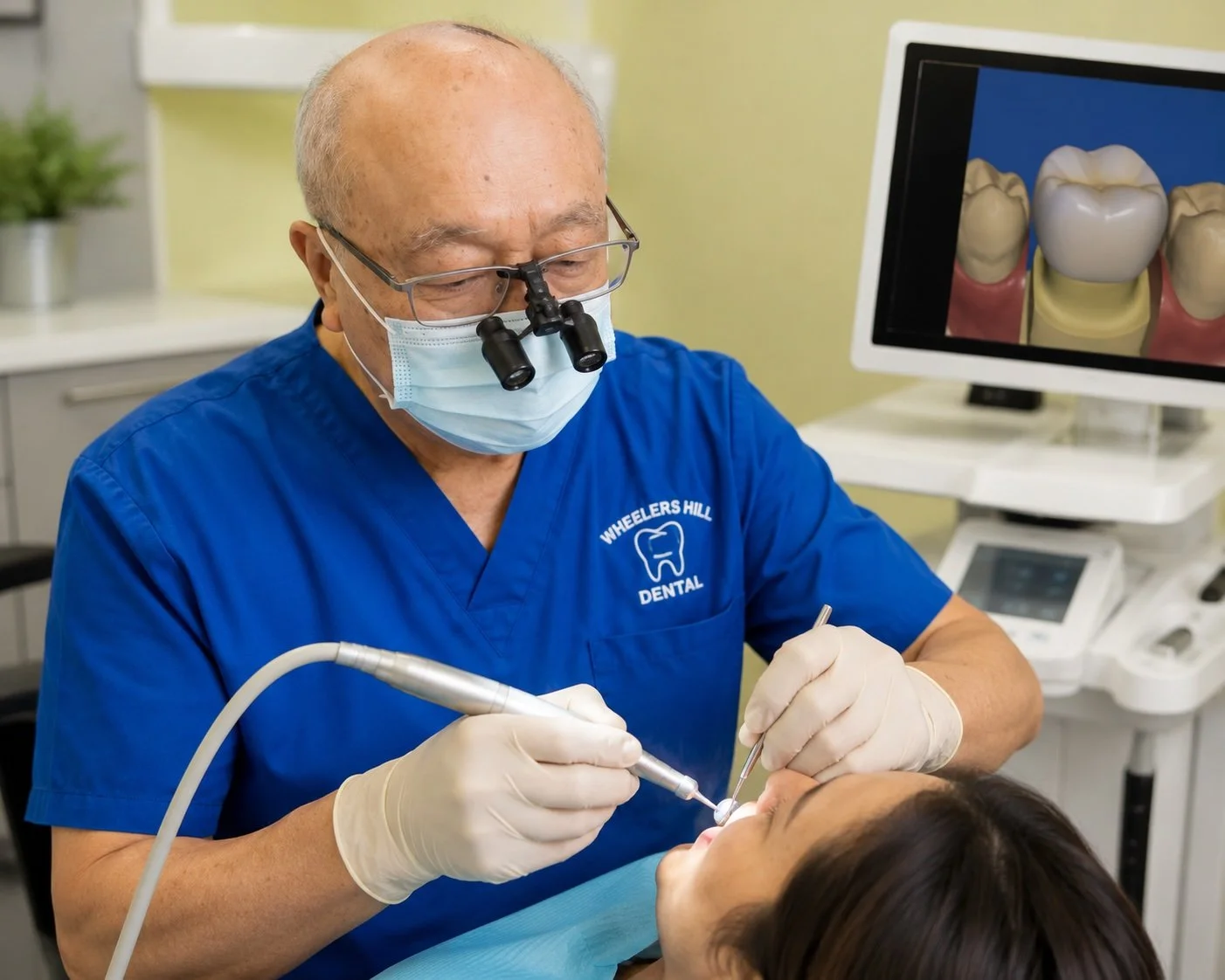
A damaged or missing tooth can affect much more than your smile. It can make eating uncomfortable, change the way you speak, reduce your confidence and place additional stress on surrounding teeth. At Wheelers Hill Dental, we provide high-quality dental crowns and bridges that restore the strength, function and appearance of your smile while helping you maintain excellent long-term oral health.
Since 1980, Wheelers Hill Dental has cared for generations of families throughout Wheelers Hill and Melbourne's south-east. Our experienced dentists combine modern technology, premium dental materials and personalised care to create natural-looking restorations that are designed to last.
Whether you have a cracked tooth, a large failing filling, have recently undergone root canal treatment or are missing one or more teeth, we will carefully assess your individual needs and recommend the treatment that offers the best long-term outcome.
Every smile is unique. That is why every crown and bridge we provide is individually designed to match your natural teeth, your bite and your facial appearance. Our goal is to restore your smile comfortably while preserving as much healthy tooth structure as possible.
Patients regularly visit us from Wheelers Hill, Glen Waverley, Mount Waverley, Mulgrave, Rowville, Scoresby, Brandon Park, Vermont South and the surrounding suburbs for high-quality restorative dentistry delivered with honesty, experience and genuine care.
What Is a Dental Crown?
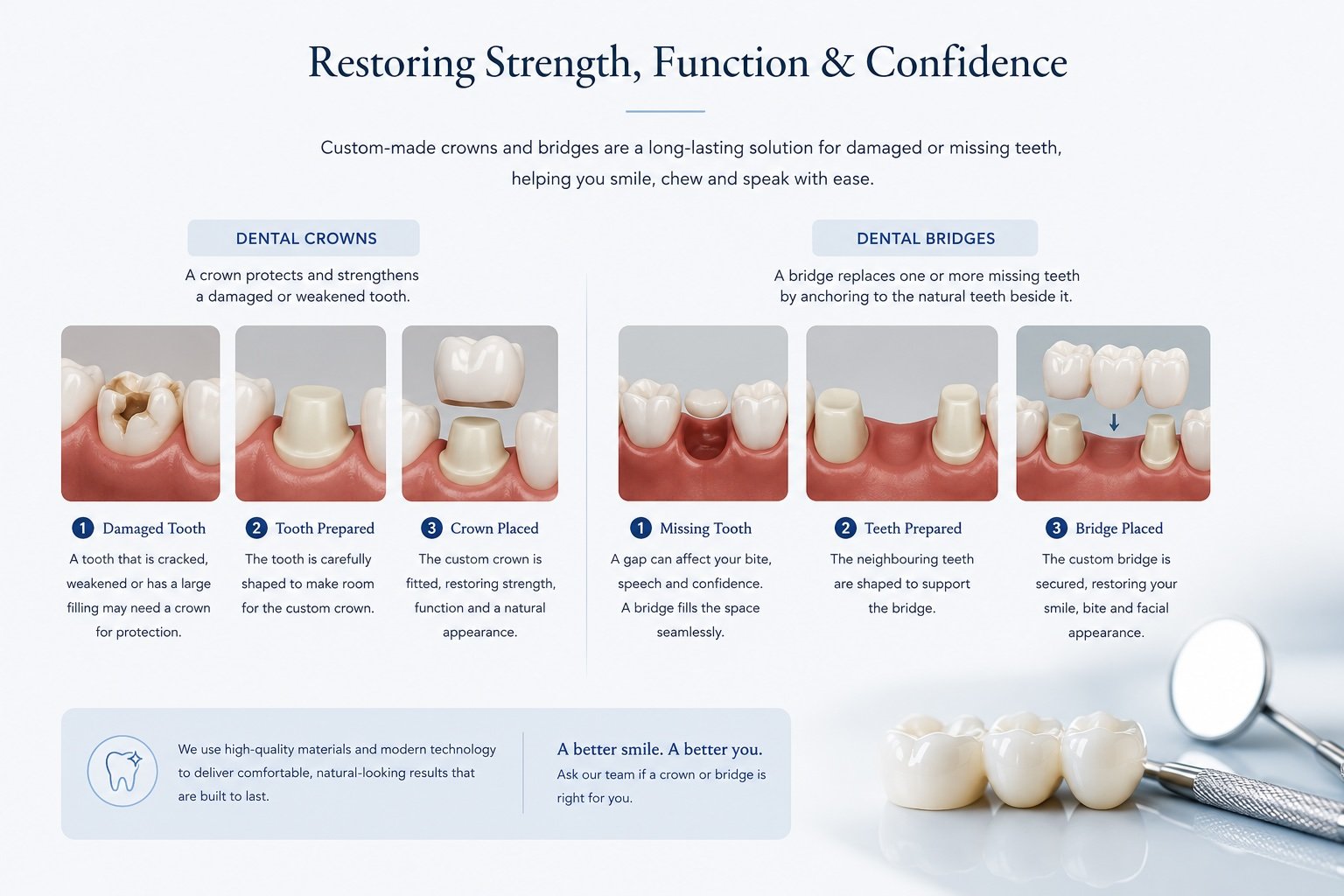
A dental crown is a custom-made restoration that completely covers a damaged or weakened tooth. Unlike a filling, which repairs only part of the tooth, a crown protects the entire visible portion above the gumline.
Modern crowns are carefully crafted to restore the tooth's:
Strength
Shape
Function
Appearance
Natural bite
Crowns are one of the most reliable ways to save teeth that would otherwise continue to crack, wear down or require extraction. By reinforcing the remaining tooth structure, a crown allows you to chew comfortably while protecting the tooth from further damage.
At Wheelers Hill Dental, every crown is individually designed to match the colour, contour and translucency of your surrounding teeth. The result is a restoration that blends naturally into your smile, allowing most people to never notice you have had treatment.
With proper care and regular dental check-ups, a high-quality crown can continue functioning successfully for many years.
When Is a Dental Crown Recommended?
Your dentist may recommend a dental crown if a tooth has become too weak to be restored safely with a filling alone.
Common situations include:
A cracked or fractured tooth
A tooth weakened by a very large filling
A tooth following root canal treatment
Extensive tooth decay
Severe tooth wear from grinding or acid erosion
A broken tooth requiring additional protection
A misshapen or heavily discoloured tooth
A dental implant requiring its final restoration
A tooth that has fractured after trauma or sporting injury
Every tooth is different. Before recommending treatment, we perform a comprehensive examination, assess your bite, evaluate digital X-rays where necessary and discuss your goals before preparing a personalised treatment plan.
Our philosophy is simple—we only recommend a crown when it offers the best long-term solution for protecting your natural tooth.
Why Might a Filling No Longer Be Enough?
Many patients ask why a crown is sometimes recommended instead of another filling.
While fillings are an excellent treatment for small to moderate areas of damage, every replacement filling requires a little more healthy tooth structure to be removed. Over time, the remaining tooth becomes thinner and more susceptible to fracture.
If too much tooth has been lost, placing another filling may actually increase the risk of the tooth splitting under normal chewing forces.
A crown surrounds and protects the remaining tooth structure, allowing biting forces to be distributed more evenly across the entire tooth. This significantly reduces the risk of further fracture while restoring strength and function.
Our dentists always aim to preserve as much natural tooth as possible. If a filling is still the most appropriate treatment, we will recommend that instead. However, if a crown offers a more predictable long-term outcome, we will explain why and answer all of your questions before proceeding.
Dental Crowns After Root Canal Treatment
Following root canal treatment, many back teeth become more brittle because the infection, previous decay and existing restorations may have already weakened the tooth.
For this reason, a crown is frequently recommended after root canal therapy to help prevent the tooth from fracturing in the future.
A custom-made crown protects the remaining tooth structure while allowing you to chew normally again. It also restores the natural appearance of the tooth so that it blends seamlessly with your surrounding smile.
Not every tooth requires a crown after root canal treatment. During your consultation, your dentist will assess the remaining tooth structure and recommend the most appropriate option based on your individual circumstances.
Can a Crown Save My Tooth?
In many cases, yes.
Modern restorative dentistry allows us to preserve teeth that years ago may have required extraction.
If enough healthy tooth remains, a dental crown can often restore strength, function and appearance while allowing you to keep your natural tooth for many years.
However, there are situations where a tooth has become too severely damaged due to advanced decay, extensive fracture or significant gum disease. In these cases, another treatment—such as a dental implant or bridge—may provide a more predictable long-term outcome.
At Wheelers Hill Dental, preserving your natural teeth is always our first priority whenever it is clinically appropriate.
What Is a Dental Bridge?
A dental bridge is a custom-made restoration designed to replace one or more missing teeth. By filling the gap left by missing teeth, a bridge restores your smile, improves chewing function and helps prevent neighbouring teeth from drifting out of position.
Missing teeth can affect far more than your appearance. Over time, they may lead to changes in your bite, increased wear on remaining teeth, difficulty chewing certain foods and even changes in speech. Replacing missing teeth promptly helps maintain both your oral health and your quality of life.
At Wheelers Hill Dental, every bridge is individually designed to look natural, feel comfortable and blend seamlessly with your existing teeth.
When Is a Dental Bridge Recommended?
A dental bridge may be recommended if you have one or more missing teeth and are looking for a fixed, non-removable solution.
You may be a suitable candidate if you have:
One or more missing teeth
Healthy teeth on either side of the gap
Difficulty chewing because of missing teeth
Teeth beginning to drift into the empty space
Changes to your bite following tooth loss
A desire for a fixed alternative to a removable denture
Every patient is different. During your consultation, we will discuss whether a dental bridge, dental implant or another treatment is the most appropriate option for your long-term oral health.
How Does a Dental Bridge Work?
A traditional dental bridge replaces the missing tooth by supporting an artificial tooth (known as a pontic) between two custom-made crowns placed on the neighbouring teeth.
The completed bridge is securely bonded into place, restoring your ability to bite, chew and smile with confidence.
Modern dental bridges are carefully crafted using high-quality materials that closely resemble natural tooth enamel in colour, shape and translucency. Most people will not be able to tell which tooth has been replaced.
Dental Bridge or Dental Implant?
Many patients ask whether a dental bridge or dental implant is the better option.
The answer depends on several factors, including:
The condition of neighbouring teeth
The amount of healthy bone available
Your general oral health
Your budget
Your long-term treatment goals
A dental implant replaces the entire tooth, including the root, without affecting neighbouring teeth.
A bridge restores the missing tooth using the support of adjacent teeth and may be the preferred option in certain situations, particularly if the supporting teeth already require crowns.
Our dentists will explain the advantages and limitations of each treatment so you can make an informed decision based on your individual circumstances.
Dental Crowns vs Fillings
One of the most common questions we hear is:
"Do I need a filling or a crown?"
The answer depends on how much healthy tooth remains.
A filling is ideal when enough natural tooth structure is still present to support it.
However, when a tooth has become extensively damaged through decay, fracture, repeated fillings or wear, another filling may no longer provide sufficient strength.
A dental crown completely surrounds the tooth, helping it withstand everyday biting forces while protecting it against further fracture.
At Wheelers Hill Dental, we always choose the most conservative treatment possible. If a filling will provide a predictable long-term result, we will recommend a filling. If a crown is likely to give your tooth a much better chance of lasting for many years, we will explain why and discuss all available treatment options with you.
Dental Crowns vs Veneers
Although crowns and veneers can both improve the appearance of teeth, they are designed for very different purposes.
A dental crown covers the entire tooth and is recommended when a tooth has been weakened by decay, fracture, root canal treatment or a large filling. Crowns restore both strength and appearance while protecting the remaining tooth structure.
A dental veneer is a thin porcelain or composite shell bonded to the front surface of a tooth. Veneers are primarily used to improve cosmetic concerns such as:
Discoloured teeth
Small chips
Uneven tooth shape
Minor gaps
Worn front teeth
If your tooth is healthy and simply requires cosmetic improvement, a veneer may be the ideal solution.
If your tooth requires significant structural support as well as cosmetic improvement, a crown is usually the more appropriate treatment.
During your consultation, we will explain the advantages and limitations of both options so you can choose the treatment that best suits your smile and long-term oral health.
Why Choose a Custom-Made Crown?
Every dental crown we provide is individually designed for your smile.
Unlike a one-size-fits-all restoration, your crown is carefully customised to match:
The colour of your natural teeth
Your bite
Your facial features
The shape of surrounding teeth
Your chewing function
Your smile aesthetics
We work closely with trusted Australian dental laboratories to produce restorations that look natural, feel comfortable and are designed for long-term durability.
Our goal is simple—to provide a restoration that is so natural most people won't even know it's there.
Benefits of Dental Crowns
Dental crowns do much more than improve the appearance of a damaged tooth. They restore strength, protect weakened tooth structure and allow you to eat, speak and smile with confidence.
Modern crowns are carefully designed to provide both functional and aesthetic benefits, making them one of the most predictable long-term restorative treatments available.
A custom-made dental crown can:
Restore the strength of a weakened or damaged tooth
Protect teeth with large fillings from further fracture
Reinforce teeth following root canal treatment
Restore normal chewing function
Improve the appearance of worn, broken or discoloured teeth
Restore the natural shape and size of a tooth
Improve your smile and self-confidence
Support long-term oral health by preserving natural teeth
Restore dental implants with a lifelike final tooth
Provide excellent durability with proper care
At Wheelers Hill Dental, our crowns are individually designed to restore your smile while preserving as much healthy tooth structure as possible.
With good oral hygiene, regular dental examinations and professional cleans, many crowns continue to function successfully for well over a decade.
Types of Dental Crowns
Not every crown is the same.
The most suitable material depends on the position of the tooth, your bite, your cosmetic goals and your individual oral health needs.
During your consultation, we will explain the advantages and limitations of each option before recommending the most appropriate restoration.
All-Ceramic Crowns
All-ceramic crowns provide exceptional aesthetics and closely resemble natural tooth enamel.
They are an excellent choice for front teeth because they offer outstanding colour matching, translucency and a highly natural appearance.
Patients wanting the most lifelike cosmetic result often choose all-ceramic crowns.
Zirconia Crowns
Zirconia crowns combine excellent strength with outstanding aesthetics.
They are highly resistant to fracture and wear, making them an excellent option for back teeth where greater chewing forces occur.
Modern zirconia materials also provide excellent cosmetic results, allowing many patients to enjoy both durability and a natural-looking smile.
Porcelain-Fused-to-Metal Crowns
Porcelain-fused-to-metal crowns combine a strong metal framework with an attractive porcelain exterior.
They have been successfully used for many years and remain a reliable treatment option in selected situations.
Your dentist will discuss whether this material is suitable for your individual needs.
Implant Crowns
Dental implants replace the root of a missing tooth.
Once the implant has integrated with the jawbone, a custom-made crown is attached to complete the restoration.
The final result is a tooth that looks, feels and functions very similarly to a natural tooth.
Why Choose Wheelers Hill Dental for Dental Crowns and Bridges?
Choosing the right dentist is just as important as choosing the right treatment.
At Wheelers Hill Dental, we have proudly cared for families throughout Melbourne's south-east since 1980, providing personalised dentistry focused on long-term oral health rather than short-term solutions.
When you choose Wheelers Hill Dental, you can expect:
Personalised treatment plans tailored to your individual needs
Comprehensive examinations before any treatment begins
Honest advice and clear explanations of all available options
High-quality crown and bridge materials selected for durability and aesthetics
Close collaboration with trusted Australian dental laboratories
Modern digital technology for improved precision
Gentle, patient-focused care designed to maximise comfort
A friendly and experienced dental team committed to helping you maintain your smile
We believe informed patients make better decisions.
That's why we take the time to explain your diagnosis, answer your questions and ensure you understand every stage of treatment before proceeding.
Our goal isn't simply to repair a tooth.
Our goal is to restore your confidence, improve your comfort and help you enjoy a healthy smile for many years to come.
Patients regularly visit us from Wheelers Hill, Glen Waverley, Mount Waverley, Mulgrave, Rowville, Scoresby, Brandon Park, Vermont South and surrounding suburbs because they value our personalised approach and commitment to quality.
Your Dental Crown Procedure
Understanding what happens during treatment helps many patients feel more relaxed and confident.
Although every case is different, most dental crowns are completed over two appointments.
Initial Consultation
Your first appointment begins with a comprehensive examination of your teeth, gums and bite.
During this visit we may:
Discuss your symptoms and concerns
Examine the affected tooth
Take digital X-rays where required
Assess the remaining tooth structure
Evaluate your bite and surrounding teeth
Discuss all suitable treatment options
Prepare a personalised treatment plan
If a crown is the most appropriate solution, we will explain why, answer your questions and provide a written treatment plan before any treatment begins.
Preparing the Tooth
Once the tooth has been comfortably numbed with local anaesthetic, any decay, damaged tooth structure or failing filling material is carefully removed.
The tooth is then gently shaped to create space for your new custom-made crown while preserving as much healthy tooth structure as possible.
Our philosophy is always to be as conservative as clinically appropriate.
Digital Scans and Shade Selection
After your tooth has been prepared, we take highly accurate digital scans or impressions.
These records allow your new crown to be individually designed to provide:
An accurate fit
A comfortable bite
Natural appearance
Excellent long-term function
We also carefully match the shade of your surrounding teeth so your new crown blends naturally into your smile.
Every detail is considered to ensure the final restoration both looks and feels like a natural tooth.
Temporary Crown
Once your tooth has been prepared, a custom temporary crown is placed to protect it while your permanent crown is being carefully fabricated by a dental laboratory.
Your temporary crown is designed to:
Protect the prepared tooth
Reduce sensitivity
Maintain your bite
Prevent neighbouring teeth from moving
Allow you to smile with confidence while your permanent crown is being made
Although temporary crowns are durable enough for everyday use, they are not intended as a permanent restoration.
While wearing your temporary crown, we recommend:
Avoiding very hard or sticky foods on that side
Brushing and flossing carefully
Contacting our practice if the temporary crown becomes loose or comes off
Most patients wear their temporary crown for approximately one to two weeks.
Fitting Your Permanent Crown
Once your custom-made crown has been returned from the dental laboratory, you will attend your second appointment.
Before permanently securing the crown, your dentist will carefully check:
The fit
The colour match
The bite
The appearance
The contact with neighbouring teeth
Your overall comfort
Minor adjustments are made if necessary to ensure the crown feels completely natural.
Once both you and your dentist are happy with the result, the crown is permanently bonded into position using a high-strength dental cement.
Most patients are pleasantly surprised by how natural their new crown feels immediately after treatment.
The Dental Bridge Procedure
The process for providing a dental bridge is similar to that of a dental crown, although additional planning is required to replace the missing tooth.
Step 1 – Comprehensive Examination
Your dentist will examine your teeth, gums and bite to determine whether a bridge is the most appropriate treatment.
Digital X-rays may be taken to assess the health of the supporting teeth and surrounding bone.
Step 2 – Preparing the Supporting Teeth
The teeth on either side of the gap are carefully prepared to support the bridge.
Every effort is made to preserve as much healthy tooth structure as possible while creating adequate space for the restoration.
Step 3 – Digital Scan or Impression
Highly accurate digital scans or impressions are taken and sent to a trusted Australian dental laboratory.
Your bridge is individually designed to:
Match your natural teeth
Restore your bite
Provide comfortable chewing
Blend seamlessly into your smile
Step 4 – Temporary Bridge
A temporary bridge is fitted while your permanent restoration is being fabricated.
This temporary restoration protects the prepared teeth and maintains the appearance of your smile until your next appointment.
Step 5 – Fitting Your New Bridge
When your custom bridge is ready, your dentist will carefully assess:
Fit
Appearance
Bite
Comfort
Colour
Once everything has been thoroughly checked, the bridge is permanently bonded into place.
The result is a fixed restoration that restores both function and appearance while helping maintain the position of your remaining teeth.
What Can I Expect After Treatment?
It is normal to experience mild tenderness or sensitivity for a few days after your crown or bridge has been fitted.
This usually settles quickly as your mouth adapts to the new restoration.
Some patients notice that the crown initially feels slightly different because it has restored the tooth to its ideal shape and contour. This sensation generally disappears within a short period as your tongue and bite become accustomed to the restoration.
If your bite feels uneven or uncomfortable after treatment, please contact Wheelers Hill Dental. A simple adjustment is often all that is required to improve comfort.
Caring for Your New Crown or Bridge
Although crowns and bridges cannot develop decay themselves, the natural tooth structure supporting them still requires ongoing care.
Maintaining good oral hygiene is essential for maximising the lifespan of your restoration.
We recommend:
Brushing twice daily with a fluoride toothpaste
Cleaning carefully between your teeth every day using floss or interdental brushes
Attending regular dental examinations and professional cleans
Limiting sugary food and drinks
Avoiding chewing ice, pens and other hard objects
Wearing a professionally made night guard if you grind or clench your teeth
For dental bridges, special floss threaders or interdental cleaning aids may be recommended to help clean beneath the artificial tooth.
Our team will demonstrate the most effective cleaning techniques to help keep both your restoration and surrounding teeth healthy.
How Long Do Dental Crowns and Bridges Last?
Dental crowns and bridges are designed to provide many years of reliable function.
Their lifespan depends on several factors, including:
Your oral hygiene
Regular dental check-ups
The amount of biting force placed on the restoration
Whether you grind or clench your teeth
Your overall oral health
Diet and lifestyle habits
With appropriate care, many crowns and bridges continue to function successfully for well over 10 years, and some may last considerably longer.
Routine examinations allow us to monitor your restorations and identify any concerns before they become more significant.
Can Every Tooth Be Saved?
Our first priority is always to preserve your natural teeth whenever possible.
Unfortunately, some teeth are too severely damaged by decay, fracture or advanced gum disease to be restored predictably with a crown.
If this occurs, we will discuss all available treatment options with you, which may include:
Dental implants
Dental bridges
Partial dentures
Other restorative solutions appropriate for your needs
We believe every patient deserves honest advice based on what will provide the best long-term outcome—not simply the quickest treatment.
Frequently Asked Questions About Dental Crowns and Bridges
Does getting a dental crown hurt?
Most patients are pleasantly surprised by how comfortable the procedure is. Your tooth will be thoroughly numbed using local anaesthetic before treatment begins, so you should not feel pain during the procedure. You may experience mild sensitivity for a few days afterwards, but this usually settles quickly.
How long does it take to get a dental crown?
Most dental crowns are completed over two appointments.
During your first visit, the tooth is prepared, digital scans or impressions are taken, and a temporary crown is fitted. Your permanent crown is then custom-made by a trusted Australian dental laboratory before being fitted at your second appointment.
How long do dental crowns last?
With good oral hygiene and regular dental check-ups, many crowns last 10 to 15 years or longer. Their lifespan depends on factors such as oral hygiene, diet, biting forces, and whether you grind or clench your teeth.
Regular examinations allow us to monitor your crown and identify any issues early.
Can a dental crown be replaced?
Yes. Like all dental restorations, crowns may eventually need replacing due to wear, damage or changes to the supporting tooth.
During your routine dental examinations, we will carefully assess the condition of your crown and advise you if replacement is ever required.
Can I eat normally with a dental crown?
Yes.
Once your permanent crown has been fitted and any initial tenderness has settled, you should be able to eat comfortably and enjoy most foods again.
Dental crowns are designed to restore normal chewing function while protecting your natural tooth.
Are dental crowns noticeable?
Modern crowns are designed to closely resemble natural teeth.
At Wheelers Hill Dental, we carefully match the colour, shape and contour of your surrounding teeth so your crown blends naturally into your smile.
Most people will never notice you have had treatment.
Is a dental bridge removable?
No.
A traditional dental bridge is permanently bonded to the supporting teeth and cannot be removed by the patient.
It functions much like your natural teeth and allows you to eat, smile and speak with confidence.
How do I clean a dental bridge?
Dental bridges should be brushed just like natural teeth.
Because the artificial tooth is suspended above the gum, special floss threaders or interdental brushes are usually recommended to clean beneath the bridge.
Our team will show you the most effective way to care for your bridge at home.
Is a dental bridge better than a denture?
Both treatments have advantages depending on your individual circumstances.
A bridge provides a fixed solution that feels more like natural teeth, whereas a denture can be removed for cleaning.
During your consultation, we will discuss all suitable treatment options and recommend the one that best meets your clinical needs, lifestyle and long-term goals.
Can a missing tooth affect my other teeth?
Yes.
When a tooth is lost, neighbouring teeth can gradually drift into the empty space. This may alter your bite, make cleaning more difficult and increase the risk of gum disease and tooth wear.
Replacing missing teeth promptly can help maintain the alignment and function of your smile.
Why Choose Wheelers Hill Dental?
Choosing a dental practice is about more than simply replacing a damaged or missing tooth. You want experienced clinicians who take the time to understand your concerns, explain your options and deliver treatment with precision and care.
At Wheelers Hill Dental, we have proudly served our local community since 1980, helping generations of families maintain healthy, confident smiles.
When you visit our practice, you can expect:
Personalised treatment tailored to your individual needs
Comprehensive examinations and clear treatment planning
Honest advice with no unnecessary treatment
High-quality materials selected for strength and aesthetics
Modern technology for precise diagnosis and treatment
Gentle, patient-focused care in a relaxed environment
A commitment to preserving your natural teeth wherever possible
Whether you require a single crown, a dental bridge or more complex restorative treatment, our goal is to provide care that looks natural, functions comfortably and supports your oral health for many years.
Book a Dental Crown or Bridge Consultation
If you have a damaged tooth, a failing filling or one or more missing teeth, early treatment can often prevent more complex problems in the future.
Our experienced team will carefully examine your teeth, explain your treatment options and recommend the solution that best suits your oral health, lifestyle and long-term goals.
We welcome patients from Wheelers Hill, Glen Waverley, Mount Waverley, Mulgrave, Rowville, Scoresby, Brandon Park, Vermont South and surrounding suburbs.
Whether you need to restore a damaged tooth or replace a missing one, we're here to help you smile with confidence again.
Call Wheelers Hill Dental today or book your appointment online to arrange your comprehensive consultation. We look forward to helping you achieve a healthy, strong and natural-looking smile.